Main Nutritious Intent Website

Wednesday, August 26, 2015

Trail Mix Navigation 101

There are loads of trail mixes out there with a new recipe for the crunchy snack popping up all the time.  However, not all trail mixes are created equal.  It can be confusing to determine what trail mixes are delicious, but the equivalent of a candy bar in bag form, what trail mixes will go stale because they are what my family refers to as "twigs and bark" and what mixes are a happy combination of flavor and nutrition.  Here are a few tips to healthfully navigate the tricky world of trail mix:

  • Visual Appeal.  It is true that we eat with our eyes first, however, if it is too colorful (candies, white chocolate and butterscotch chips making up the bulk) then beware.  Your sugar content is likely too high and nutrient content such as fiber, vitamins and minerals too low.
  • 3 Food Groups Represented.  Nuts and dried fruits, while healthful are very calorie dense so watch portion size with those combinations.  A better option is to choose a mix of 3 food groups.  Whole grains provide fiber, complex carbohydrates and protein for longer fullness and energy, dried fruits provide a quicker energy source as well as some vitamins and minerals and nuts or seeds will balance it out with some healthful fats for satiety, as well as some protein and vitamins and minerals also.  
  • Pre-Portion Wisely.  Most trail mixes will contain 100-200 calories per 1/2 cup serving.  Pre-portioning not only keeps your serving size in check, but it ups the convenience factor as you are a packing a lunch or grabbing a snack before soccer practice. 
Cherry Chocolate Brownie Trail Mix

Here are 4 Trail Mix recipes that mix it up nutrient-wise and flavor-wise.

Traditional Trail Mix
2 cups bran flakes
2 cups Kashi Crisp
1/2 cup pumpkin seeds
1/2 cup almonds
1/2 cup reduced sugar dried cranberries
1/2 cup unsweetened flaked coconut

1/2 cup = 160 calories, 4 g fiber, 5 sugar, 6 g protein

Savory Trail Mix
2 cups wheat squares cereal (Chex)
2 cups multigrain pretzels
1 cup sun-dried tomatoes, chopped
1/2 cup smokehouse almonds
1/2 cup cornnuts

1/2 cup = 125 calories, 3 g fiber, 3 g sugar, 4 g protein

Apple Pie Trail Mix
1 cup apple cinnamon Cheerios
1 cup cinnamon graham cereal
1 cup dried apples (pieces)
1/2 cup yogurt-covered raisins
1/2 cup pecan halves

1/2 cup = 155 calories, 2 g fiber, 18 g sugar, 2 g protein

Cherry Chocolate Brownie Trail Mix
1 cup wheat square cereal (Chex)
3 cups Cocoa Puffs Brownie Crunch cereal
1 cup dried cherries
1/2 cup lightly salted peanuts
1/2 cup dark chocolate M&Ms

1/2 cup = 145 calories, 2 g fiber, 14 g sugar, 3 g protein


Monday, August 10, 2015

Grocery Shopping: Front Lines for Nutritional Health


4 rules will help you stay healthy while you navigate that shopping cart:

1.    Plan your menu out in advance.  Don’t just list the main dish, but make note of side dishes, and healthful snack items you’re planning on eating during the week.
2.    Make your grocery list from your menu.  If you have the ingredients for a week’s worth of meals on hand, you can swap the order of your menu if you find your mood changes come dinnertime without resorting to less healthy convenience items.
3.    Make buying produce a priority.  Depending on the season you will probably want to go with a balance of fresh and frozen produce.  Remember that if half of what  you eat should be plants, half of your grocery cart should be full of produce.
4.    Plan and purchase snacks mindfully.  If it isn’t in the house, we aren’t going to eat it, so make sure to buy with healthful snacking in mind.  For example popcorn, nuts, individually wrapped dark chocolate, and lower sugar frozen yogurts may fill your snacking and fit the nutrition bill as well.

Tips by store section:

Bakery/Grains: 3 grams or more fiber per serving

 Produce: In season and variety are key

Butcher: Go meatless a couple nights a week and vary your animal protein sources

Canned Fruits: Watch out for added sugar

Canned Veggies: Watch out for added sodium

Dairy: Choose low-fat & unsweetened

Are You Eating Smart and Making the Grade? Here’s How to Feed Your Brain:

Whether you are starting preschool or law school, you'll want to make sure you're getting the right balance of nutrients to stay sharp.

Carbohydrates are what fuels our brains.  Make sure you’re getting a good variety of whole grains daily.  Fruits and vegetables can also contribute healthy-fuel carbohydrates.

Healthful fats from a variety of sources keep your circulation healthy and reduce inflammation not just for your heart, but for your brain as well.  Salmon, Tuna, Walnuts, Pumpkin seeds and Flaxseed oil are all great sources of heart and brain healthy fats that we often just call Omega-3s.  Remember that what is healthy for your heart is healthy for your brain.

Protein: A good balance of nutrients is important and a little protein at mealtimes help keep you fuller longer, as well as supply your body with the building blocks it needs to make neurotransmitters, hormones and other essential compounds for healthy brain function.


How to work these components in? 
  •       Pair a whole grain with a protein and a fruit for a great, long-lasting breakfast. (Top yogurt with fruit, & nuts and serve with whole grain toast)
  •       Include some healthy seeds and nuts in a trail mix for your child’s lunch sack or after-school snack. 


Crunch Combo Trail Mix:

1/2 cup dried cherries, 2 cups whole-grain Rice Chex, 1/2 cup roasted pistachios, 3 cups Kashi Go Lean Crunch Cereal
1/2 cup mix = 119 calories 3.3 g fiber

Chocolate-lover's Trail Mix:

2 cups cheerios, ½ cup pepitas, ¼ cup raisins, ¼ cup semisweet mini chocolate chips

1/3 cup mix =  120 calories, 2 g fiber

Tuesday, July 28, 2015

Want to improve your health? Enjoy your food.

Lots of evidence supports the health benefits of enjoying your food.  The French are famous for spending loads of time on their meals, savoring delicious rich dishes, yet they don’t have the obesity problem we do.  The French spend  more than 2 hours per day eating and drinking.  Americans spend 1 hour.  Studies show that eating under stress or with other stimuli reduces the absorption of certain minerals.  Also, how you view your food also affects how much nutrition you get from your food.  The cephalic phase of digestion is the term for your brain's reaction to the anticipation of food.  More digestive acids and enzymes are produced when you anticipate delicious, appealing food.  These chemicals help absorb vitamins and minerals found in food.  So enjoying nutritious food that is delicious and appealing to you ends up benefiting you more than choking down a nutritious but  unwanted meal.  

Besides savoring your food, it also pays to listen to your body as  you eat.  Using a scale from one to ten, you can rate your hunger and fullness levels.  Paying attention to what we really physically need when it comes to food is key to long-term good health.  Before you eat, assess what level of hunger you are at.  While eating, check in with your body to see how full you are getting.  It's generally best for meals to start eating at a 3 and end at a 6 or 7.  When  we get too hungry (say 1 or 2) we tend to eat so quickly that we over shoot how much food we really need, and end up at an 8, 9 or 10.  

Hunger/Satiety Scale


0          1          2          3          4          5          6          7          8          9          10

0 = Starving – ravenous, dizzy, no energy to move
1 = Famished – light headed, weak, can't concentrate
2 = Painfully hungry – stomach pain, irritable
3 = Strong hunger – stomach growling
4 = Slightly uncomfortable - 1st signs of hunger
5 = Neutral – not hungry, not full
6 = Comfortable – satisfied
7 = Full
8 = Uncomfortably full – definitely should have stopped eating sooner.
9 = Stuffed – painfully full, tired, sluggish
10 = Sick – so full and bloated that you feel nauseous. 


The more mindful we are as we eat, and the more enjoyment we find in food.  More enjoyment means stress levels will decrease and we will be less likely to plough through the ice cream pint or the bag of cheese puffs -  thoughtlessly eating our way to obesity, heart disease and diabetes.  The take home message is that multi-tasking may actually end up multiplying your health problems.  Plan in time for food and allow it to not only nourish your body, but your soul. 

Tuesday, July 21, 2015

Corn: Not Just Fuel for Your Gas Tank

It’s a veggie. . . it’s a grain. . . it’s corn! 


Myth’s surround one of America’s favorite summer dishes.  Here’s the truth about wonderfully versatile corn:

  1. Myth: Isn’t most corn GMO (genetically modified organism)?  Only 3-4 % of sweet corn grown in the US was GMO last year. 
  2. Myth: Corn is high in sugar and dangerous carbs. Nope.  An ear of corn contains the same amount of calories of an apple and only ¼ the sugar.  What you slather on it afterward may be a different story. 
  3. Myth: Corn doesn’t contain any real nutrition beyond fiber. While it’s true that fiber is a real nutrition selling point – one ear contains 3 grams of fiber, it is also loaded with healthful nutrients.  Corn contains protein and lots of B vitamins.  Sweet corn contains lutein and zeaxanthin which are phytochemicals with promote healthy vision. 
  4. Myth: Corn is a culinary one-trick-pony available for just a few month each year.  These cooking ideas are great ways to use leftover corn on the cob, but frozen corn is a tasty and wonderful substitute year round. 

o   Soup: Creamy soups and chowders are deliciously thickened by blending in some cooked corn.
o   Salads: you don’t have to go to a salad bar to enjoy corn on your salad.  Work it into any of your favorite fresh salads.
o   Pizza: Corn is my latest favorite pizza topping.  It adds great texture and natural sweetness that balances well with the other strong flavors of pizza.

o   Baked Goods: Add in a cup or two of corn kernels and a can of green chiles into your favorite cornmeal muffin mix for a quick, delicious southwestern side.  A fun twist would be to cook it in a waffle iron, top with chicken, salsa and a little cheese for a tex-mex twist on chicken and waffles.


Tex Mex Chicken & Waffles

1 small (8.5 oz) box of corn muffin mix - prepared according to package instructions
1 can (4 oz) diced green chiles
1 1/2 cups corn kernels (fresh or frozen) 

2 cups shredded roasted chicken
4 oz. shredded colby jack cheese
1 cup salsa

Mix chiles and corn into corn muffin batter.  Cook in waffle iron.  Top with shredded or diced roasted chicken, salsa and cheese.  Enjoy!


Monday, July 20, 2015

Keep Kids Cooking

Summer may mean that all routine goes out the window, but it also means that kids have more time at home to start learning to plan and prepare meals.  My daughter has been cooking for 4 years now, and although we're not ready to start our own kid-prodigy-cooking-reality TV show, 4 years of cooking dinner once a week has provided her with some skills.
This was a simple, but tasty dinner she made for us recently.  Corn on the cob, roasted potatoes, marinated-grilled chicken with a creamy shallot sauce and tossed salad.  More than just the basic cooking of an entree, we work on planning 2-3 veggie or fruit dishes with each meal.  If you're not ready to start cooking classes with your kiddos this summer, here are 3 easy ways get your kids ready to start cooking:

  1. Let them plan a menu.  When you plan out your weekly or monthly menu, have them help you plan out what dishes they'd like to try.  Be sure that they include 2-3 fruit or vegetable dishes to go along with the entree. (You can take this a step further and have them help grocery shop for that week's menu.)
  2. Have them set the table.  As the habit of sitting down to family dinner goes by the wayside, so does health and nutrition.  Eat together, and have your kids learn how to set a proper table that accommodates your menu.
  3. Have them help wash and prep.  Rinsing produce, putting frozen peas in a bowl to be microwaved, or tearing up lettuce for a salad are safe, simple ways to start giving your kids ownership of the meal.  What they help plan and prepare, they are more likely to eat.  
So without being overwhelmed, start small and work your way up to teaching your children to cook.  Few life-skills will serve them better that cooking and enjoying healthful food.  And although it may be frustrating, it does pay off - that picture above is proof!

Monday, July 13, 2015

Stay Cool in a Smart Way: Frozen Treats

 Dog-days of summer cry out for frozen treats such as slushes, ice-cream, and popsicles.  But are some choices better than others when it comes to cooling off with something frozen? Here are some things to look for when choosing frozen treats from the store.

   Serving size: one-kid-hand rule – if a child can hold it with one hand, then chances are the serving size is reasonable.  (Monstrously large slushes in huge cups – not so much).  If you have a package with a nutrition label – 100 calories or less is a good target to shoot for with creamy treats and closer to 50 calories for fruity frozen treats. 

   Ingredient list: the shorter the better and something other than sugar as the first or second ingredient.

Freeze your own
   Save out some smoothie, freeze it in a cup and enjoy it frozen another time.

   Involve your kids – let them choose what fruit combinations to blend and freeze. Freezing in cups is simpler doesn't require fancy popsicle molds, is dripless and forces you to slow down.  Slower eating means more enjoyment, more relaxation and better nutrition.  

   Bypass the blender and enjoy the whole fruit frozen: grapes and berries make great bite-sized frozen snacks, put a stick in a spear of pineapple, mango, melon or banana for the most wholesome and simple frozen treat. 
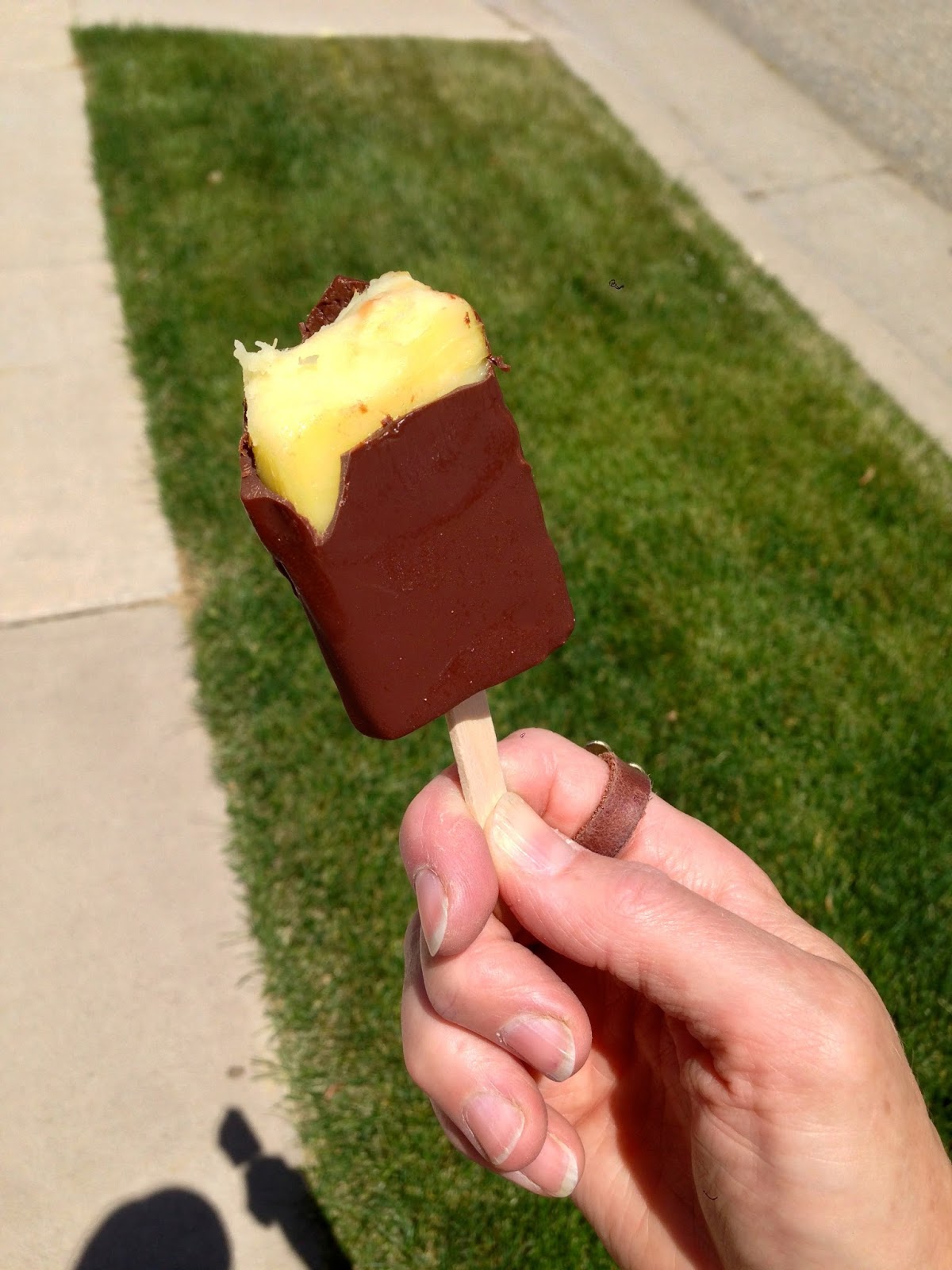
Chocolate-dipped pineapple - affectionately called choco-pina in Guatemala made me fall in love with this delicious treat. Super simple to make.

Being intentional in your choice of cool-down treats can help you stay hydrated and boost your nutrition at the same time. 


Choco-pina Recipe:

  1. Put popsicle sticks partway into spears of fresh pineapple.  Freeze (I put them on wax-paper-lined baking sheets)
  2. Melt a small amount of dark chocolate mixed with a little coconut oil.  (I know this sounds vague, but it depends on how much pineapple you are doing.)  I usually melt 1/2 cup chocolate chips and 1-2 tablespoons of coconut oil.
  3. Dip frozen pineapple into melted chocolate mixure.  Place back on wax paper and freeze.  
  4. When frozen, wrap in plastic wrap or put in zip-top bags.  Keep in Freezer.
  5. Enjoy!